What is a Custom CRM? Everything You Need to Know in 2026
Introduction
Managing customer relationships is no longer just about storing contact information. Modern businesses need systems that streamline sales, automate repetitive tasks, improve customer service, and provide real-time insights. This is where a Customer Relationship Management (CRM) system becomes essential.
While many companies start with popular CRM platforms, growing businesses often discover that these solutions don't fully align with their unique workflows. That's when a Custom CRM becomes the better choice.
In this guide, we'll explain what a Custom CRM is, how it works, its key benefits, and why investing in one can help your business scale more efficiently.
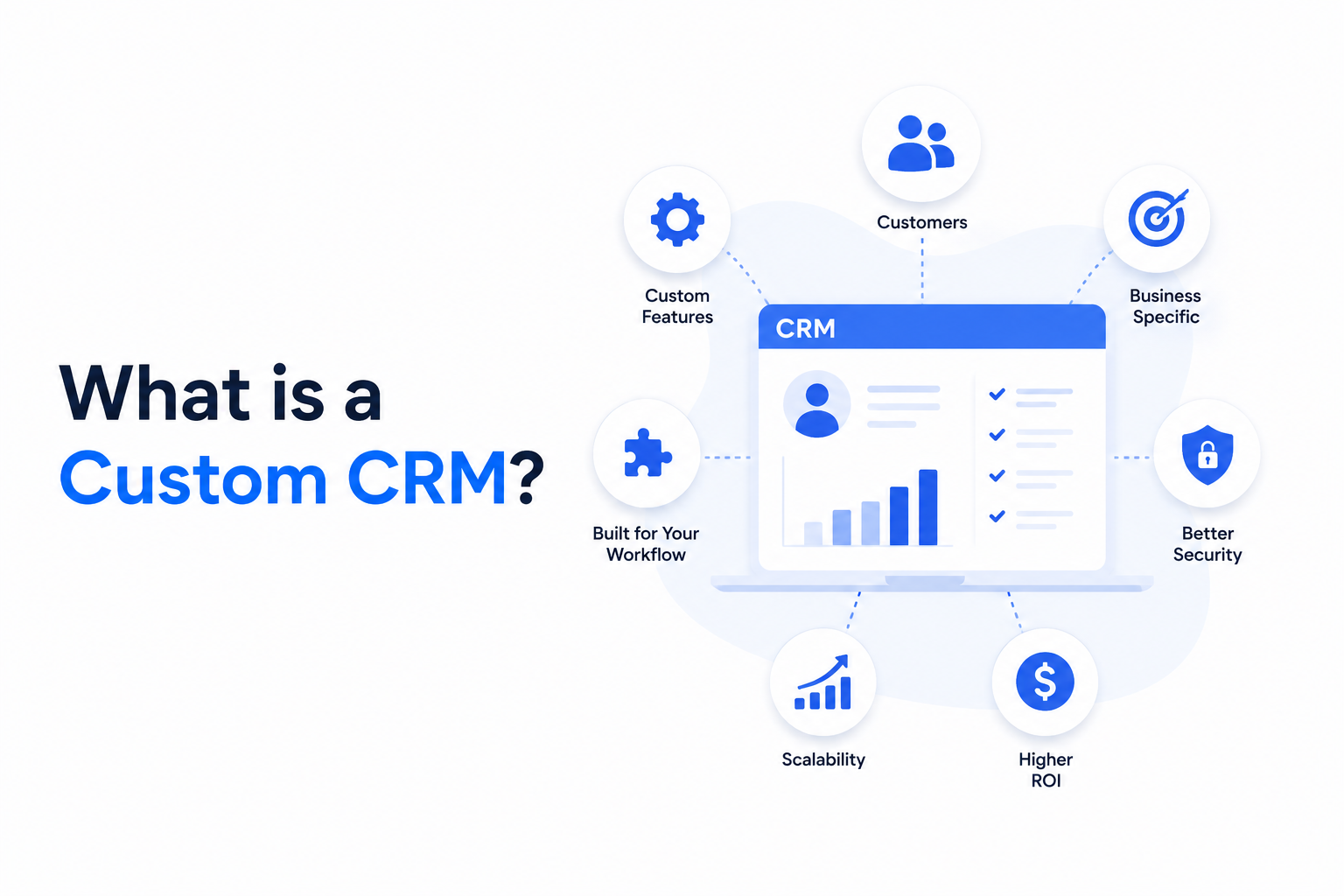
What is a Custom CRM?
A Custom CRM (Customer Relationship Management) is software designed and developed specifically for your business processes, goals, and operational requirements.
Unlike ready-made CRM platforms that offer generic features for a broad audience, a custom CRM is built around the way your organization actually works.
Instead of changing your business to fit the software, the software is built to fit your business.
For example, a travel agency may require visa tracking, itinerary management, and supplier coordination, while a manufacturing company may need production tracking, inventory synchronization, and dealer management. A custom CRM accommodates these unique requirements from the outset.
How Does a Custom CRM Work?
A Custom CRM centralizes all customer-related information in one secure platform. It allows teams to:
- Store customer information
- Track sales opportunities
- Manage leads
- Monitor customer interactions
- Automate workflows
- Generate reports
- Integrate with third-party software
- Improve collaboration across departments
Because every business has different processes, each CRM can be tailored with modules that support specific operational needs.
Custom CRM vs. Off-the-Shelf CRM
| Feature | Custom CRM | Off-the-Shelf CRM |
|---|---|---|
| Built for your business | ✅ | ❌ |
| Custom workflows | ✅ | Limited |
| Unlimited scalability | ✅ | Limited |
| Third-party integrations | Fully customizable | Limited |
| Ownership | Complete | Vendor controlled |
| Monthly licensing fees | No recurring per-user fees | Ongoing subscription costs |
| Flexibility | High | Moderate |
While platforms like Salesforce or HubSpot work well for many organizations, businesses with specialized workflows often benefit from a CRM built specifically for their operations.
Key Features of a Custom CRM
Contact Management
Maintain a centralized database of customers, leads, and prospects with complete interaction history.
Lead Management
Capture, assign, and track leads throughout the sales pipeline.
Sales Pipeline Tracking
Visualize every opportunity from initial inquiry to successful conversion.
Workflow Automation
Automate repetitive tasks such as:
- Follow-up emails
- Task assignments
- Notifications
- Approval processes
- Invoice reminders
Reporting and Analytics
Access real-time dashboards showing:
- Sales performance
- Revenue trends
- Team productivity
- Customer acquisition
- Conversion rates
Role-Based Access
Grant different levels of access to employees based on their responsibilities.
Third-Party Integrations
Integrate seamlessly with:
- ERP systems
- Accounting software
- Payment gateways
- Marketing platforms
- Email services
- SMS providers
- Cloud storage
Benefits of a Custom CRM
1. Built Around Your Workflow
Your employees don't have to adapt to software limitations. The CRM supports your existing processes, making adoption easier and improving productivity.
2. Increased Productivity
Automation reduces manual tasks, allowing teams to focus on high-value work such as sales, customer service, and business growth.
3. Better Customer Experience
With all customer data in one place, teams can respond faster, personalize interactions, and provide more consistent service.
4. Scalable as Your Business Grows
A Custom CRM evolves with your business. New modules, users, and features can be added without replacing the entire system.
5. Stronger Data Security
You have greater control over data storage, user permissions, backups, and compliance with your organization's security requirements.
6. Long-Term Cost Efficiency
Although the initial investment may be higher than a subscription-based CRM, businesses often save money over time by avoiding recurring licensing fees and reducing operational inefficiencies.
Industries That Benefit from a Custom CRM
Custom CRM solutions are valuable across many industries, including:
- Travel Agencies
- Hospitality
- Real Estate
- Healthcare
- Manufacturing
- Education
- Logistics
- Financial Services
- E-commerce
- Professional Services
Each industry has unique operational requirements that can be addressed through tailored CRM functionality.
Signs Your Business Needs a Custom CRM
You may benefit from a Custom CRM if:
- Your team relies heavily on spreadsheets.
- Employees manually repeat the same tasks every day.
- Existing CRM software requires numerous workarounds.
- Multiple departments use disconnected systems.
- Reporting is time-consuming or inaccurate.
- Customer information is scattered across different tools.
- Your business has unique workflows that generic software cannot support.
How a Custom CRM Improves Business Growth
A well-designed CRM enables businesses to:
- Increase sales conversions
- Improve customer retention
- Shorten sales cycles
- Enhance team collaboration
- Automate business processes
- Make data-driven decisions
- Deliver personalized customer experiences
These improvements contribute to sustainable growth and operational efficiency.
How RapidRabbit Builds Custom CRM Solutions
At RapidRabbit, we design and develop CRM systems tailored to each client's business model and objectives.
Our development process includes:
- Business process analysis
- Workflow mapping
- UI/UX design
- CRM architecture planning
- Custom software development
- Third-party integrations
- Testing and quality assurance
- Deployment
- Ongoing support and enhancements
Whether you need a sales CRM, customer support platform, project management system, or an industry-specific solution, we build software that aligns with your operational needs.
Frequently Asked Questions
Is a Custom CRM better than a standard CRM?
It depends on your business. Companies with unique workflows, specialized processes, or scalability requirements often gain greater value from a custom-built CRM.
How long does it take to develop a Custom CRM?
Development timelines vary depending on project complexity, required features, and integrations. A simple CRM may take a few weeks, while enterprise-grade systems can take several months.
Can a Custom CRM integrate with existing software?
Yes. Custom CRM solutions can integrate with accounting platforms, ERP systems, payment gateways, email providers, communication tools, and many other business applications.
Is a Custom CRM secure?
Yes. Security measures such as encrypted data storage, role-based permissions, audit logs, multi-factor authentication, and regular backups can be implemented based on your organization's requirements.
Conclusion
A Custom CRM is more than just software—it is a strategic investment in your business operations. By aligning technology with your unique processes, a custom CRM improves efficiency, enhances customer relationships, and supports long-term growth.
If your current systems are limiting productivity or failing to meet your business needs, it may be time to explore a solution built specifically for your organization.
Ready to transform the way you manage customers? Contact RapidRabbit to discuss a Custom CRM solution tailored to your business.