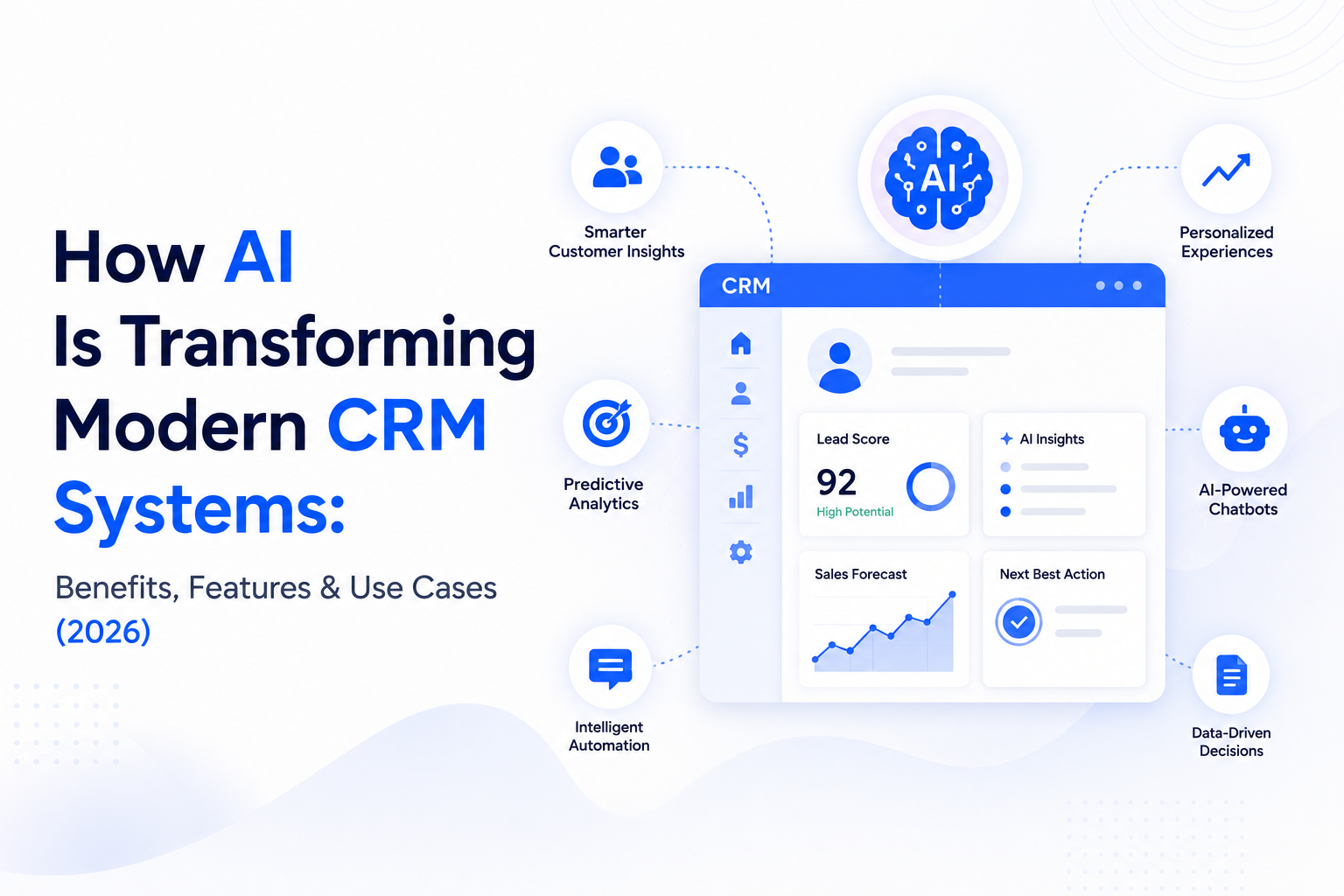
How AI Is Transforming Modern CRM Systems: Benefits, Features & Use Cases (2026)
Introduction
Customer Relationship Management (CRM) systems have evolved far beyond digital contact books. Today, businesses expect their CRM to do more than store customer information—they need intelligent systems that automate repetitive tasks, uncover valuable insights, predict customer behavior, and help teams make faster, data-driven decisions.
This evolution is being driven by Artificial Intelligence (AI).
AI is transforming modern CRM systems by making them smarter, more proactive, and highly personalized. Instead of simply managing customer data, AI-powered CRMs analyze vast amounts of information to recommend actions, prioritize leads, automate workflows, and improve customer experiences.
In this guide, we'll explore how AI is reshaping CRM systems, the key benefits for businesses, and why integrating AI into your CRM can provide a significant competitive advantage.
What Is an AI-Powered CRM?
An AI-powered CRM combines traditional customer relationship management with artificial intelligence technologies such as:
- Machine Learning (ML)
- Natural Language Processing (NLP)
- Predictive Analytics
- Generative AI
- Intelligent Automation
- Conversational AI
These technologies help businesses automate decision-making, identify patterns, and provide actionable recommendations based on customer data.
Instead of employees manually analyzing reports or updating records, AI handles much of the work automatically, allowing teams to focus on building stronger customer relationships.
Why Businesses Are Adopting AI in CRM
As businesses grow, managing customer interactions manually becomes increasingly difficult.
Sales teams often struggle with:
- Hundreds of leads
- Multiple communication channels
- Repetitive administrative work
- Inconsistent follow-ups
- Delayed responses
- Large volumes of customer data
AI solves these challenges by automating routine tasks while providing intelligent insights that improve decision-making and productivity.
How AI Is Transforming Modern CRM Systems
1. Intelligent Lead Scoring
Not every lead has the same potential.
AI analyzes customer behavior, demographics, engagement history, website visits, email interactions, and purchasing patterns to identify which prospects are most likely to convert.
Instead of contacting every lead equally, sales teams can prioritize high-value opportunities.
Benefits
- Higher conversion rates
- Better sales productivity
- Reduced time spent on unqualified leads
- Faster revenue generation
2. Predictive Sales Forecasting
Traditional sales forecasting often relies on assumptions or historical spreadsheets.
AI continuously analyzes:
- Pipeline activity
- Customer engagement
- Previous sales cycles
- Seasonal trends
- Market behavior
It predicts future revenue more accurately and helps businesses identify risks before they become problems.
3. Automated Data Entry
One of the biggest frustrations with traditional CRM systems is manual data entry.
AI automatically captures information from:
- Emails
- Phone calls
- Meeting notes
- Forms
- Chat conversations
- Calendar events
This reduces administrative work while improving data accuracy.
4. Personalized Customer Experiences
Modern customers expect personalized communication.
AI analyzes customer preferences, purchasing history, browsing behavior, and previous interactions to recommend personalized:
- Products
- Services
- Offers
- Marketing campaigns
- Follow-up messages
Personalization improves customer satisfaction and increases conversion rates.
5. AI Chatbots and Virtual Assistants
AI-powered chatbots provide instant customer support 24/7.
They can:
- Answer frequently asked questions
- Book appointments
- Collect lead information
- Schedule demos
- Qualify prospects
- Route complex queries to human agents
This reduces response times while improving customer experience.
6. Workflow Automation
AI eliminates repetitive manual work by automating everyday business processes.
Examples include:
- Assigning new leads
- Sending follow-up emails
- Creating reminders
- Updating deal stages
- Scheduling meetings
- Escalating customer issues
- Generating invoices
- Triggering approval workflows
Automation improves efficiency and reduces human error.
7. Smart Email Recommendations
AI helps sales representatives craft better emails by suggesting:
- Subject lines
- Responses
- Follow-up timing
- Personalized content
- Meeting reminders
Some AI-powered CRM systems can even generate complete email drafts based on previous customer interactions.
8. Customer Sentiment Analysis
Using Natural Language Processing (NLP), AI can analyze emails, chats, surveys, and support conversations to determine customer sentiment.
It identifies whether customers are:
- Happy
- Frustrated
- At risk of leaving
- Ready to purchase
This allows teams to respond proactively and strengthen customer relationships.
9. Predictive Customer Retention
Losing customers is expensive.
AI identifies early warning signs that indicate a customer may stop doing business with your company.
These indicators include:
- Reduced engagement
- Declining purchases
- Negative support interactions
- Lower product usage
- Missed renewals
Businesses can then take proactive steps to improve retention.
10. AI-Powered Analytics
Traditional CRM reports explain what happened.
AI explains:
- Why it happened
- What is likely to happen next
- What actions should be taken
Instead of simply displaying charts, AI provides actionable recommendations that help businesses improve performance.
Real-World Applications of AI in CRM
Sales Teams
AI helps sales representatives:
- Prioritize qualified leads
- Predict deal success
- Automate follow-ups
- Generate proposals
- Improve closing rates
Customer Support
Support teams use AI to:
- Respond instantly
- Categorize support tickets
- Recommend solutions
- Detect customer frustration
- Reduce response times
Marketing Teams
AI enables marketers to:
- Segment audiences automatically
- Personalize campaigns
- Predict customer interests
- Optimize email timing
- Improve campaign ROI
Business Leaders
Executives gain:
- Real-time dashboards
- Revenue forecasts
- Customer insights
- Operational analytics
- Better strategic decision-making
Benefits of AI-Powered CRM
Businesses implementing AI within their CRM systems often experience:
- Improved sales productivity
- Faster customer response times
- Higher lead conversion rates
- Better customer retention
- More accurate forecasting
- Reduced operational costs
- Enhanced customer satisfaction
- Increased employee efficiency
- Smarter decision-making
- Scalable business operations
Common AI Features in Modern CRM Systems
An AI-powered CRM may include:
- Intelligent lead scoring
- Predictive analytics
- Smart search
- Voice assistants
- AI-generated emails
- Workflow automation
- Customer sentiment analysis
- Meeting summaries
- Opportunity recommendations
- Automated reminders
- Sales forecasting
- AI-powered dashboards
- Document analysis
- Customer segmentation
- Chatbots
The exact feature set depends on the business's goals and industry requirements.
Challenges of Implementing AI in CRM
While AI offers significant advantages, successful implementation requires careful planning.
Common challenges include:
- Poor data quality
- Lack of user adoption
- Complex integrations
- Privacy and compliance requirements
- Choosing the right AI features
- Employee training
Businesses that start with clearly defined objectives and clean customer data are more likely to achieve successful outcomes.
Why Custom CRM Systems Are Ideal for AI Integration
Many off-the-shelf CRM platforms offer built-in AI features, but they are often limited to predefined workflows and generic use cases.
A custom CRM allows businesses to integrate AI in ways that directly support their unique processes.
For example, an AI-powered custom CRM can:
- Recommend travel packages based on customer preferences
- Predict project delays in construction
- Identify high-value patients in healthcare
- Forecast inventory demand in retail
- Automate approval workflows for financial services
Because the CRM is built around your operations, AI becomes a strategic business tool rather than just an add-on feature.
How RapidRabbit Builds AI-Powered CRM Solutions
At RapidRabbit, we develop custom CRM systems that combine automation with artificial intelligence to help businesses work smarter.
Our AI-powered CRM solutions can include:
- Intelligent lead management
- Workflow automation
- AI chatbots
- Predictive analytics
- Customer behavior insights
- Automated reporting
- Third-party integrations
- Role-based dashboards
- Personalized customer journeys
Every solution is designed around your business processes, ensuring that AI delivers measurable operational improvements instead of unnecessary complexity.
Frequently Asked Questions
Can AI replace CRM software?
No. AI enhances CRM software by making it more intelligent and efficient. The CRM remains the central platform for managing customer relationships, while AI automates tasks and provides insights.
Is AI CRM suitable for small businesses?
Yes. Small businesses can benefit from AI features such as lead scoring, workflow automation, chatbots, and predictive reporting without needing large teams.
Does AI improve customer service?
Yes. AI enables faster responses, personalized interactions, automated support, and proactive issue resolution, leading to better customer experiences.
Is a custom AI CRM better than a standard CRM?
For businesses with specialized workflows, industry-specific processes, or advanced automation needs, a custom AI-powered CRM provides greater flexibility, scalability, and long-term value than a generic solution.
Conclusion
Artificial Intelligence is redefining what CRM systems can achieve. From intelligent lead scoring and predictive analytics to automated workflows and personalized customer experiences, AI empowers businesses to operate more efficiently while building stronger relationships with their customers.
As customer expectations continue to evolve, organizations that combine CRM with AI will be better positioned to improve productivity, increase sales, and deliver exceptional service.
If you're looking to build a CRM tailored to your unique business processes, integrating AI from the start can help future-proof your operations and unlock new opportunities for growth.